



Advertising mode: editorial-only; no operator CTA or promotion.
RTP and volatility describe different properties of a game's design. Neither tells you whether a particular spin will win or what an individual session will return.
Use the exact game’s information panel and do not treat a statistic as a prediction.
Quick comparison
| Term | What it describes | What it cannot tell you |
|---|---|---|
| RTP | Long-run designed return across many plays | One person’s result or session |
| Volatility | Typical spread or swing of outcomes | When a win will happen |
| Game version | Configuration shown in a release | Whether future outcomes are favourable |
Steps to take
- Check the current information on the operator or provider.
- Confirm direction, account eligibility, currency and any stated limitations.
- Keep a non-sensitive reference and use official support if a question remains.
Original illustrations
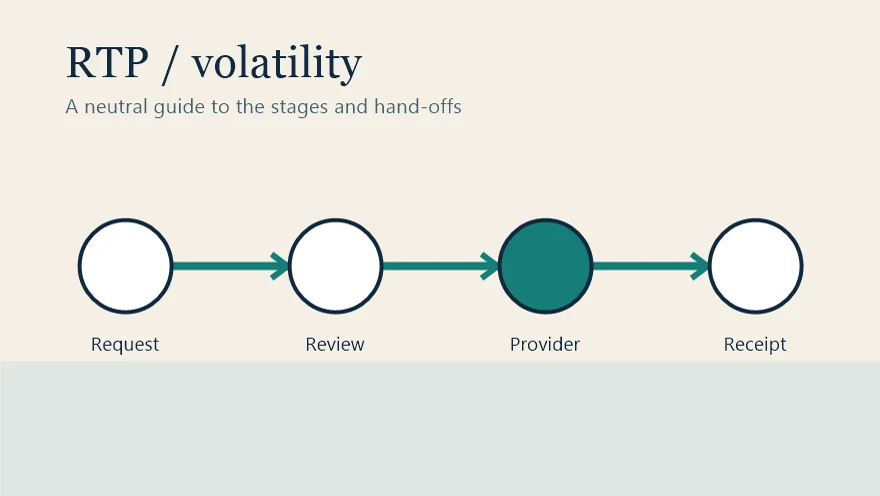
Slot-mechanics diagram and abstract reel artwork.

RTP is a long-run measure
The Gambling Commission describes RTP as the percentage of stakes a gaming machine or game is designed to return over a very large number of plays. It is not a promise for a player or session.
Volatility describes result distribution
Volatility is commonly used to describe how results are distributed over time: a more volatile design may have less frequent but larger swings, while a lower-volatility design may produce smaller fluctuations more often. Definitions and labels are not standardised across all studios.
Check the exact game version
Read the information panel for the specific release and operator version. A game title may have different configurations. Use a primary studio source where available, and confirm it matches the version presented.
Random outcomes do not follow a due pattern
Previous spins do not make a future spin due. Do not treat a streak or RTP statistic as a strategy or forecast.
Frequently asked questions
Does RTP predict a session result?
No. It is a long-run design measure, not an individual forecast.
Does a previous losing streak make a win due?
No. Past outcomes do not make a future random outcome due.
Common slot mechanics
A wild symbol may substitute for another symbol where the paytable allows it; a scatter may trigger a feature when the stated condition is met; a respin repeats part of a game sequence; and a cascade or tumble may remove winning symbols and refill the grid. These labels describe common design patterns, not standard rules: a feature can behave differently or be absent in another release. Check the exact game’s information panel for the trigger, paylines or ways-to-win, and any feature restrictions.
Online slots stake limits in Great Britain
As checked on 11 November 2026, the Gambling Commission guidance says the maximum stake per online slot game cycle is £2 for adults aged 18–24 and £5 for adults aged 25 or over. The £5 limit took effect on 9 April 2025 and the £2 limit on 21 May 2025. These limits apply to online slots only, not other casino games such as roulette or blackjack. Check the current UKGC guidance for the full definition and any current updates. This regulatory limit does not predict or improve an outcome.
Sources and related pages
See UKGC's RTP explanation, Starburst details and safer gambling information.
Sources
- UK Gambling Commission — Online slots stake limit guidance
- UK Gambling Commission — Return to player: how much do gaming machines payout?